Research at the Precision Engineering Center
The Infrared Multiobject Spectrometer (IRMOS)is being developed by NASA and the Space Telescope Science Institute to look into the origins of the universe using first ground-based telescopes and ultimately the James Webb Space Telescope. A key element in the design of the spectrometer is the use of non-rotationally symmetric optical elements to reduce overall package size. The PEC’s extensive experience in this area of diamond turning is well suited to the task of producing these mirrors, yet it is not without its challenges. The mirror to be fabricated is an off-axis section of a biconic (a sort of distorted ellipsoid) with a departure from rotationally symmetric of about 350 µm. A deviation from a rotational toolpath of this magniude is too large for the PEC’s direct-acting Fast Tool Servo, which has a range of only 40 µm. A fast tool servo with a longer range is thus needed. A commercially available Fast tool servo that uses a mechanical amplification scheme to acheive a range of 400 µm has been selected for the mirror fabrication. This increase comes at the expense of frequency response, but is not a significant problem for a part that only requires two servo excursions for every spindle revolution.
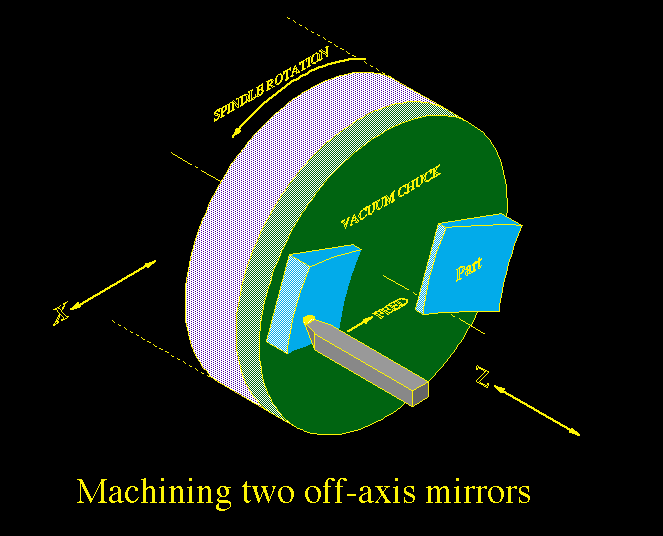
Machining will be performed on the PEC’s Nanoform 600 Diamond Turning Machine. A external DSP controller will gather spindle and axis position information from the DTM controller to position the Fast tool servo. Two off-axis mirrors will be mounted on a specially designed chuck to rotate at a speed of 50-100 r.p.m. (see figure 1). As the parts rotate past the tool, the FTS will move the tool to produce the non-rotationally symmetric portion of the surface (see figure 2, animation)

Setup for machining two biconic mirrors
Animation showing FTS operation

Following fabrication, metrology of the resulting surface is important for verifcation purposes. Since standard interferometry methods do not work with anamorphic and aspheric surfaces, two methods will be used to measure the biconics: 3-D Profilometry and Interferometry using holographic reference masks. A translation stage will be fitted to the PEC’s Form Talysurf profilometer so that a series of parallel line scans can be acquired and assembled into a complete 3-D profile of the surface. This technique has been used to measure the form of an off-axis paraboloid machined on-axis with a Fast Tool Servo. The drawback to this method is that it scratches the surface of the part as a result of the contacting stylus. In the second measurement method, a holographic reference mask will be fitted to the PEC’s 6″ Zygo GPI interferometer to provide a wavefront reference. The disadvantage of this method is that alignment can be difficult, the holographic masks are expensive and cannot be directly verified for accuracy. At the conclusion of these measurements, the mirrors will be shipped to NASA GSFC for optical testing.
The following faculty, students, and PEC affiliates are involved in this project:
The following faculty, students, and PEC affiliates are involved in this project:
| Faculty | Students | Affiliates |
| Alex Sohn Ken Garrard |
NASA |